
Minutes Writing Made Simple {A Detailed Guide with Clear Examples}
- ounglish
- Dec 16, 2021
- 9 min read

Updated: Dec 26, 2021

Have you ever been called upon to take minutes during a meeting and you didn't know where to start? Do you consider Minutes Writing to be one of the most challenging topics in Functional Writing? Well, I've prepared this post on minutes writing with samples with you in mind. If you read this post to the end, writing minutes will be a piece of cake for you. In this rare to find article, I get down to the details that are often ignored by most writers on this topic.
In order for you to clearly understand the process of writing minutes, I will take a step by step approach. I will first explain what minute writing is. I will then give a clear definition of minutes. Furthermore, I will outline the format of minute writing, and finally give examples. Stay with me till the end to get a clear understanding of minutes.
Minutes Writing Definition
It might be tricky for me to claim that there is a specific minutes writing definition. Instead, I will put you on the right track by describing what it entails. This way, you will clearly understand and appreciate what it really is.
Minutes writing refers to the act of recording the issues discussed in a meeting. These issues are the ones called minutes. Each issue that has been discussed and agreed upon is recorded as a single minute. Minutes are normally taken by the secretary in an official meeting. When all the minutes are considered as an entity or a whole, they form the proceedings of a meeting.
Importance of Minutes Writing
It is worthwhile for us to first discuss the Importance of minutes writing. Minutes writing is important for the following reasons:
It is an important writing skill because the minutes recorded help the members in remembering the issues that have been tackled in the past. This way, it becomes easy to plan for the future.
Again, minutes seal the loophole of someone claiming in future that an issue had been agreed upon, while in real sense it was not even discussed.
Minutes help in holding members accountable. For each issue discussed, appropriate actions are agreed upon and a member or a group of members are assigned to act on them. For instance, if it is discussed and agreed that some items will be bought, it is recorded clearly in the minutes who will be responsible for the purchase.
Minutes are legal documents that can be used in legal proceedings, since no one can deny the truth in the written records. Why is this so? Before minutes are confirmed, all the members must agree that they are a true record of what transpired in the said meeting.

Minutes Writing Format
Some students find it difficult to understand minutes writing format. I will make it clear for you in this article. The format of minutes, like any other functional writing item, begins with the heading. The sections below the heading will depend on whether the minutes are for a first meeting or or not.
If it is a first meeting, there will be no items pertaining to a previous meeting. After all, it is the first meeting! However, if it is a second or subsequent meeting, then there will be issues pertaining to the previous meeting. This is very important for you to understand from the onset.
Let us begin by outlining the minutes format for each type of meeting before we get into a deeper discussion on the parts of minutes. We will first list the parts of each type of minutes format before we discuss what they really are.
Minutes Writing Format for a First Meeting
Minutes Writing Format for a first meeting will consist of the following parts:
The minutes heading or title
Members Present
Members absent with apologies
Members absent without apologies
In Attendance
Preliminaries
Business of the day (has three or more sub-headings)
A.O.B (Any Other Business)
Adjournment
Next meeting
Minutes Writing Format for a Second or Subsequent Meeting
The minutes heading or title
Members Present
Members absent with apologies
Members absent without apologies
In Attendance
Preliminaries
Reading and Confirmation of the Previous Minutes
Matters Arising
Business of the day (has three or more sub-headings)
A.O.B (Any Other Business)
Adjournment
Next meeting

To this end, it should be crystal clear that when writing minutes, you should first check the kind of meeting it is. It could be a first meeting; it could also be a second or subsequent meeting. Subsequent here means any meeting that is not the first of the year. It could be the second, the third, fourth and so on.
Most of the subtitles or sub-headings will be the same, only that for a second or subsequent meeting, you include two more headings after preliminaries, namely "Reading and Confirmation of the Previous Minutes" and "Matters Arising".
Let us now discuss what each part means.
The Minutes Heading or Title
The minutes heading or title should mention four things:
The group that is having the meeting, for example the Debating Club
The date of the meeting, for example 10th February 2022
The venue of the meeting, for example, the School Dining Hall
The duration of the meeting, for example, from 2 pm to 4pm
The above items should be carved together to form the minutes heading, for example:
"Minutes of the Debating Club Meeting Held on 10th February 2022 in the School Dining Hall from 2 pm to 4pm".
Members Present
Under the sub-heading Members Present, write a list of all the members present, starting with the chairperson and the secretary. Indicate the role of the chair and the secretary. For the rest, you can write "Member" against each name or just list the names without assigning roles.
Members Absent With Apologies
Under the sub-heading "Members Absent With Apologies", list the members who have not attended the meeting but sent apologies to the chair that they would be absent.
Members absent without apologies
Under the sub-heading "Members Absent Without Apologies", list the members that are not present in the meeting but did not send their apologies to the chair.
In Attendance
Under the subtitle "In Attendance", write the name of a person or list the names of people who are not official members of the group but are attending the meeting as guests, or owing to the post they hold in the organisation. For instance if the Debating Club Patron attends the club's meeting, the patron's name should appear here with the extension - Club Patron.
Preliminaries
Preliminaries are the initial steps taken before the meeting officially begins. In most cases, the chairperson calls the meeting to order and then asks one of the members to pray.
Reading and Confirmation of the Previous Minutes
This only happens in a second or subsequent meeting. At this stage, the chairperson asks the secretary to read the minutes of the previous meeting. Once the secretary is through with the reading, the chairperson asks one of the members to confirm if what has been read by the secretary is a true record of what transpired in the previous meeting. Another person is asked to second, that is, to re-confirm. This double confirmation ensures that only true records are confirmed.
After the confirmation by members, the chairperson and the secretary sign the minutes to make the records officially binding to all members.
Matters Arising
Here, the chairperson allows members to raise concerns, make corrections or give a follow-up on what was discussed and agreed in the previous meeting. A member can propose a correction to the spelling of a name or highlight any other grammatical error in the confirmed minutes. Another member who was given a responsibility to carry out can give a report, for instance, a member who was charged with the responsibility of purchasing some items can give a report on whether the items were purchased at the prices agreed.
Generally, all the concerns of the members about the minutes of the previous meeting are raised at this point. This sets the stage for the business of the day.
Business of the Day
The business of the day refers to the agenda items to be discussed in the current meeting. A typical meeting will schedule at least three issues to be discussed in each meeting. Taking the example of the Debating Club above, they might have the following items under business of the day:
Election of new leaders
Inter-school debate
A trip to parliament
Note that each item under the business of the day will be a different heading, therefore, the term "Business of the Day" will not appear as a heading in the actual written minutes. For the case above, the three items listed will be a separate subtitle and each will be discussed separately.
If the Debating Club members are having their first meeting of the year, then the minutes will consist of the following:
The Minutes heading or title
Members Present
Members absent with apologies
Members absent without apologies
In Attendance (if any)
Preliminaries
Election of new leaders
Inter-school debate
A trip to parliament
A.O.B
Adjournment
Next Meeting
If it is a second or subsequent meeting, the minutes will consist of:
The heading or title
Members Present
Members absent with apologies
Members absent without apologies
In Attendance (if any)
Preliminaries
Reading and confirmation of the previous minutes
Matters arising
Election of new leaders
Inter-school debate
A trip to parliament
A.O.B
Adjournment
Next Meeting
Minutes Confirmation
Minutes are normally confirmed in subsequent meetings. After writing the minutes of a meeting therefore, the secretary finishes with the sub-heading "Confirmed by". Below this, the words "Chairperson" and "Secretary" are written with spaces for each to write their name and sign in the next meeting after the minutes are confirmed.

Minutes Writing: Numbering of Minutes
There is need for proper numbering of minutes for easy reference. Remember the members refer to the minutes when raising concerns on matters arising in subsequent meetings. An individual member will also need to easily access to the sections of the minutes that require their follow-up or attention. For instance, a member who has been charged with the responsibility of purchasing items will have to check the list of items and the approved budget before making the purchase.
In an event that the minutes are to be used in legal proceedings, it will be more convenient if the sections being referred to can easily be accessed. To achieve this, minutes are normally numbered. The abbreviation MIN is used with some numbers stroked against each other, followed by the sub-heading or subtitle. It is also a good practice to number the paragraphs to achieve the same purpose - ease of reference.
EXAM TIP
In written examinations, write the heading and sub-headings in capital letters and leave a space between them and the paragraphs. You can also consider underlining the heading and the sub-headings.This makes your work neat and clear.
Look at these examples:

The above sub-heading refers to the first minute in the first meeting of 2022. You can also choose to include the month, especially for a group that holds several meetings every month. Here is an example of the same subtitle with the month included.

The above subtitle refers to the first meeting of February 2022.

The above subtitle is for adjournment. Note that the next meeting has been included. Most minute writers combine the two sub-headings to make their work easier. There is no harm in that.
For groups that only have several meetings in a year and not on a monthly basis, the subsequent meetings are numbered as a continuation of the previous ones. The next meeting for the above subtitle can begin with minute 16 as shown below:
Now that we are through with the headings, let us look at how the paragraphs of minutes look like.
Minutes Writing: Paragraphs
The paragraphs of minutes should adopt correct language and numbering. Although the numbering is optional, it is a good practice for ease of future reference. Before we look at an example, let us explore the appropriate language for minutes.
Minutes Writing: Language
In minute writing, you are reporting what transpired in a previous meeting. Reported speech and passive voice are therefore used. The most important detail in minute writing is what was discussed and agreed, and not who said what. As a result, the names of members are excluded when reporting what they said. Instead, the general term "member" is used. This is to avoid future victimisation, because the contents of minutes are normally adopted by all members. A member's name or post is only mentioned when they are given a responsibility to take action on a given minute.
It is also important to note that for every sub-heading, you have to note what was discussed and what was agreed. If you only indicate the issues discussed without the conclusions arrived at, your minutes will be considered to be hanging. Here is an example of a complete minute entry.
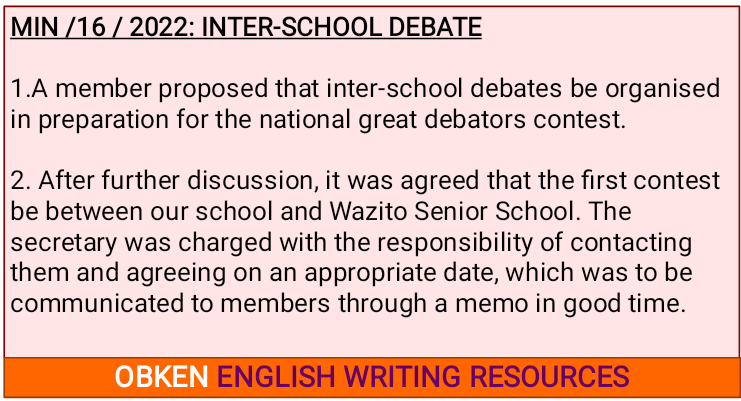
From the above example, we can clearly come up with the following conclusions:
The member who gave the suggestion is not named
Members discussed about the suggestion
They agreed to hold a contest with Wazito Senior school
The secretary was to contact Wazito and communicate the date to the members through a memo.
It is also clear from the above paragraph that the only time a member can be named is when they are given a responsibility to carry out.
Note also the numbering of the paragraphs which makes reference easy, as one can simply refer to them as either paragraph 1 or paragraph 2 of inter-school debate. This is not mandatory though.
A good paragraph in minutes should therefore answer the following questions:
What was discussed? - inter-school debate.
What was agreed? - a contest with Wazito Senior School.
Who was to take an action - the secretary.
Which action? - communicate with Wazito and set a date, then send a memo on the agreed date to the members.
Points to Remember
When writing minutes, make sure you have the right heading and proper sub-headings.
The paragraphs should be written in the passive voice using reported speech.
Names of contributing members should not be mentioned unless when a member is given a responsibility.
Confirmation of the previous minutes and matters arising are sub-headings used only in second and subsequent meetings.


Comments